

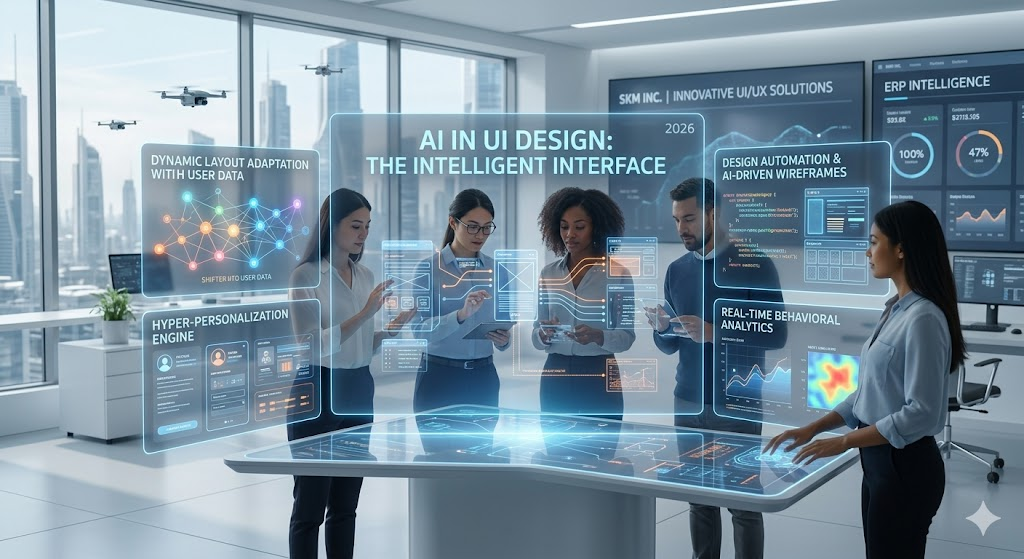
In the modern digital landscape, when a website or application feels effortless—intuitive navigation, relevant content, and zero friction—it is rarely a coincidence. More often than not, it is AI-driven UI design working tirelessly behind the scenes.
For business owners, SMEs, and tech stakeholders, this shift from static layouts to intelligent interfaces represents a significant competitive edge. In 2026, the question is no longer if you should use AI in your design process, but how effectively you are leveraging it.
What is AI in UI Design?
AI in UI design utilizes machine learning, data analytics, and natural language processing to create interfaces that are behaviorally smart. Unlike traditional design, which delivers a fixed layout to every visitor, an AI-powered user interface adapts in real-time. It understands who is using it and what they are trying to accomplish.
“AI doesn’t replace the designer’s creative vision—it gives that vision the power to respond dynamically to every individual user, at scale.”
Key Benefits: Why Intelligent UI Matters
Integrating AI into the design phase provides four transformative advantages:
- Hyper-Personalization: Interfaces adapt to individual behavior, surfacing the exact features, content, and flows a specific user needs at that moment.
- Design Automation: AI tools can now generate wireframes, flag UX bottlenecks, and suggest layout improvements instantly, slashing design cycles.
- Data-Driven Validation: Real-time behavioral data replaces guesswork, ensuring every button placement and color choice is backed by evidence.
- Universal Accessibility: AI automatically detects and corrects accessibility gaps (like color contrast or screen-reader compatibility), ensuring an inclusive experience for all.
Real-World Applications: From Logistics to ERP
The value of AI in web design is already being felt across heavy industries:
- Logistics & Shipping: Intelligent dashboards surface predictive alerts and anomalies, allowing operators to make faster decisions with fewer manual checks.
- E-commerce: Adaptive checkout flows adjust based on user hesitation, significantly cutting cart abandonment rates.
- Custom ERP Systems: Role-based layouts evolve based on a worker’s daily habits, hiding unused features and highlighting critical tasks to boost productivity.
At SKM Inc, we believe that software should be genuinely intelligent, not just functional. We incorporate these AI-enhanced principles into every custom ERP and software solution we develop.
Navigating the Challenges
While the potential is vast, businesses must navigate this transition with care:
- Data Privacy: Personalization requires data. Compliance with DPDPA (India) and GDPR is mandatory to maintain user trust.
- AI Bias: Designers must ensure training data is diverse to prevent interfaces that inadvertently disadvantage specific user groups.
- The Human Touch: Over-automation risks a “robotic” feel. Brand personality and human intuition must still lead the creative process.
The Road Ahead: The Future of UI
The future of UI design belongs to generative interfaces—systems that build themselves in real-time based on a user’s prompt. We are moving toward emotion-aware systems that detect user frustration and adjust the UI to be more helpful, and Natural Language UX, where the interface responds to what the user describes rather than what they click.
Conclusion
AI in UI design is no longer experimental; it is actively reshaping how businesses compete. Companies that embrace these intelligent frameworks today will see higher retention, better efficiency, and sustained growth. The interface of the future is adaptive, personal, and intelligent—and at SKM Inc, we are building it today.
Ready to Build Smarter Software?
Don’t settle for a static interface. SKM Inc builds custom software and ERP solutions with intelligent, AI-enhanced interfaces tailored specifically to your business needs.

Comments